
The Definition of Creativity: How Disconnection is All You Ever Need

 dragon, business cartoons, creativity, talent,
Do
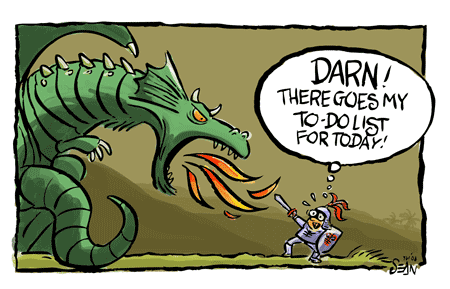
you find this cartoon funny?
Do you know the single powerful element that makes it funny?
And what makes one person creative and the other, um, not so-creative?

It’s the understanding of disconnection.
It’s the understanding of talent.
And creativity.

Talent is the combination of many emotions, memories, patterns and repetitions, implemented at high speed.

So what’s creativity?
Creativity, is simply ‘talent’ + ‘disconnected objects.’

So what is the meaning of the term ‘disconnected objects?’
When two objects or situations aren’t related, and force-fitted together, they form something we call ‘creative.’
To explain ‘creativity,’ we actually have to put in a few examples. And let’s take those examples from cartooning for instance.

Cartooning is ‘supposed to be’ a highly creative ability (yeah right)!
If you could take a movie of a cartoonist’s brain in ultra-slow motion, here’s what you’d see. You’d see  the combination of many emotions, memories, patterns and repetitions. And the you’d see how that cartoonist was drawing a cartoon that’s super-funny.

So what made the cartoon super-funny?
They took a regular situation. And disconnected it.

Example 1: On Air-New Zealand we have the Koru Hour. The Koru Hour is when you actually get served cheese, grapes and wine on your flight at no extra cost. Well, so what’s so funny about an air-hostess serving cheese and wine?

There’s nothing funny.

Yet, if we changed that plane into a canoe. And an air-hostess like person was serving cheese, grapes and wine as everyone paddled. Now that’s funny.

Example 2:
Imagine a person saying in the Arctic, fully bundled up with warm clothing, saying: “I don’t care what they say.  I feel cold.”

That’s not funny is it?

Now imagine Mamma Polar Bear and Baby Polar Bear in the Arctic. And baby polar bear is saying: “I don’t care what they say.  I feel cold.”

Instantly, the image brings a smile to your face, doesn’t it?

Example 3:
When a person leaves a relationship, they often say: “You’ll never find another person like me.” And they storm out.
(Ok, so that is anything but funny).

So let’s tweak that situation a bit. Let’s say a comedian is reciting the same thing. Here’s what the comedian would say: “I hope I never find another like you. I mean you don’t get out of  a bad relationship expecting to find another exactly like the person who’s left do you? You actually hope you don’t find another like her. Man, that would be tough on you. Having back to back trouble. You get out of a relationship, because you think it’s bad, don’t you? You don’t get out of a relationship saying: “Hey do you have a twin?”

So let’s analyse what made that funny
Oh, we covered that at the top, didn’t we?
What made the cartoons and the gag funny was a single element in each case.
In Example 1: We changed the plane to the canoe.
In Example 2: We changed the freezing person to a freezing polar bear.
In Example 3: We took a standard, stock statement, and put in a disconnected person like a ‘twin.’

In every instance, what stamped a factor of creativity, was simply one disconnection.
When every black singer was singing soul back in the 60’s it wasn’t considered creative. When Elvis Presley started singing soul, it suddenly became creative. When you write a term like “he fell to the carpet,” it isn’t considered creative. When you write “The carpet rushed up to meet the falling man,” it becomes creative.

You want the definition of creativity?
There it is: The definition of talent + Disconnection.

A to-do list isn’t funny.
Thinking about a to-do list when fighting a dragon, is um, creative. 🙂
That’s all there is to it.

Permission to be wimpy: Why talent seems unattainable

borg.jpg

In the early 1970s, men’s tennis was dominated by Americans.
In your wildest imagination you would not believe that a Swede would change all that.

The name of this Swede was Bjorn Borg.

In less than 10 years, Borg made an entire country ‘talented.’

Some of the most impressive tennis players like Mats Wilander, Stefan Edberg and dozens of other players sprouted from the Swedish woodwork.

About the same time, a woman called Martina Navratilova surfaced from Czechoslavakia. She too, started winning everything in sight.

And then, magically, the Czechs became talented.

The very same phenomenon surfaced in India

Before the year 1985, the Indian cricket team was considered to be a second-class cricket team.

Then from nowhere, they rose to win the World Cup against all odds. And from then on, you’d be slightly mad if you had a one-day tournament, and didn’t have the Indian team as an active participant.

What causes an entire country to suddenly be talented in a sport?
Surely it can’t be inspiration. If it were inspiration, then any one from any country could simply be inspired to do the same.

You see there’s quite another factor at work.

It’s called pride.

Or a lack of wimpiness
Because so-called talent requires hard work. There’s not a single ‘talented’ musician who doesn’t put in many, many hours of hard work. There’s not a single speaker, dancer, writer, athlete, teacher who simply ambles in, and oozes talent.

Talent is the culmination of so many factors, that it almost seems magical.

And unique.

And that’s because we see the expression of talent in a matter of minutes. We see a person draw a cartoon in a few seconds; write an article in an hour; play a difficult piece of music in a matter of minutes. And they seem to be so talented.

Yet the reason we aren’t talented, is because we’re wimpy.

Most people give themselves the permission to be untalented.

And we don’t have to look to the Bjorn Borgs or Martina Navratilovas to find so-called talent.

If you look around you, you’ll find some families seem to be overly talented.
They seem to be involved in the arts, writing, music and somehow seem to be so very creative.

But stop and think about it for a second.
What stops your kids from being as talented?
What stops you from being more talented?

It’s the stupid, nonsensical belief that people were born with talent.

That one country is more talented than another.
That one family is more talented than yours.

Don’t tell that to the Swedes
Here’s what Bjorkman, himself a world No.4 has to say: “We were so good that we spoiled everyone at home. There was no way we could keep winning Davis Cups, have No. 1s and Grand Slam singles champions.

We played the Davis Cup semifinals last year and were not even nominated for the top five teams in Sweden. I think people do forget some of the achievements we still create in tennis because they compare everything to the past.”

And here’s what Bjorn Borg himself has to say:
“We are struggling with the junior tennis in Sweden, but we’re working very hard to improve that. They’re also struggling in Australia”.

“But I think this goes in a circle. Sweden produced players for many, many, many years, unbelievable players. It’s impossible to continue to
do that forever”.

“But I’m sure Swedish tennis and Swedish juniors, we will be back. But it’s going to take quite a few years.”

Can you spot the wimpy-talk in the language?
Talent doesn’t arise from wimpy talk.
It arises from action. And patterns. And layering. And emotions.

“I think” is not a powerful emotion. It’s a doubt.

I think is wimpy.
Recognise that in your own life. Cut out the wimpy talk and get moving towards creating real talent.

Because talent starts with emotion. If you don’t believe you can do it, you never will.

How Emotion Plays A Role In Creating Talent

Benjamin Zander, famous orchestra conductor and co-author of the 'Art of Possibility' has a story to tell. Benjamin had a twenty-five year old problem. He had thirty students that were going to go through two semesters of training with him. The students were all...

Defining the Concept of Talent

There are many ways to define talent. Most of them are wrong. Here's how one dictionary defines talent: 1. a special natural ability or aptitude: a talent for drawing. 2. a capacity for achievement or success; ability: young men of talent. 3. a talented person: The...

How Talent Is ‘Created’

People believe they're good at drawing...or bad at drawing How this this crazy notion come about? How did we get it into our heads that we were good or bad at something? I'll tell you how. Let's take drawing, because most people simply can't draw... So why can't they...